Showing posts with label CP Estes. Show all posts

Monday, March 12

Silver Hands and...

While I still have several more of the “classic” fairy tales to go, I didn’t want to leave the question of Plot alone too long. This story is a lesser known tale, and the version I have summarized here is an amalgam of two of the better versions I’ve come across. You are welcome to do some research on your own. (Aarne-Thompson classifies it as type 706--"The Armless Maiden.") Since this is an older, less known story, some versions have elements that are unfamiliar to our modern sensibilities (in terms of morals, cultural norms, and symbolism).
Silver Hands—also called “The Orchard”—became one of my favorite fairy tales after I grew up. I never heard of it as a child (which is saying something, since I devoured fairy tales back in the day). Clarissa Pinkola Estes, who I’ve quoted before in this blog, does an extraordinary job of breaking this story into its pieces and parts in her book Women Who Run With the Wolves. I do not intend to dissect the story here, but this story is ideal for mapping out a plot.
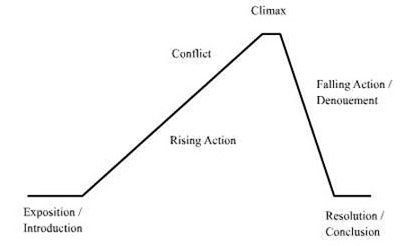
Now, a clearly marked plot can be one of the hardest things for a writer to generate. We like a character, we like a scenario, we like an adventure, but breaking it into things like “rising action” or—heaven forfend —“mid-point” is sometimes asking too much. The classical plot structure with its asymmetrical graph is often still taught in schools.
 
 Even when writers think it too simple for the complex details vying for attention, this version can help a writer think in a straight line. The evolution of film led to what is now called “the three-act plot structure”—a veritable minefield of clichés and predictable outcomes.
Don’t get me wrong. I like movies. When they’re good. I like structure and rules for stories. A six-hundred page run-on sentence about the difference between a pimple and a pickle would get old fast. Plot is a good idea.
The trouble is, an author needs the reader to want to be on the same roller coaster that she is writing. Which is why I’m using “Silver Hands” for this analysis.  As you’ll see in the summaries page, I broke down and used an extra paragraph for this story. Partly because it is a long, richly textured story that deserves more attention than I gave it, but mostly because this story breaks almost perfectly into three acts. Looking at the events of the story can make it difficult to use the classical plot structure, though. Which event is the climax? How can we have an inciting incident before we’ve meet all the characters?
This is easily answered. For the classical plot structure of this story, examine the heroine’s emotional journey. Instead of three separate and intense stories, her emotions follow one straight line. In film, this is ideally what happens. A character undergoes a series of events that all tie into one emotional journey. I believe there’s actually a little more leeway in printed media (books, short stories, poetry, etc.), but the idea is the same.
Which is why the 3-act structure is used in helping writers construct their stories. For this week, take apart Silver Hands. Use the plot graphs given here (or that you find in your own research) to break the story into its acts and actions, upheavals and downswings, development and deconstruction.
Try it. You’ll like it...

Friday, January 13

The Goose Girl and that Spotted Hanky

When last we left our heroine, she was trapped in a miserable, dead-end job while a catty betrayer took over the life that should have been hers. And all over a lost handkerchief. What’s a girl to do?
Before this devolves into some sort of whiny chick lit, let’s have another look at what that handkerchief symbolized.
In “The Goose Girl”, the queen-mother did everything she could to protect the princess. She gave the princess the safest childhood, the best quality of life possible, and chose a stable, kind family for her daughter to marry into. Then, when she had made as many choices as for her daughter as possible, the queen also surrounded the girl with strong things that should have protected her: a servant, a horse, and a handkerchief.
A servant of both strong will and cunning understanding. A horse who could talk—even after death. And the last of the queen’s gifts: a spotted handkerchief. When the servant saw it float downstream, she knew the princess had lost the queen’s protection. The princess did not lose her own gentle authority (else the wind would not have obeyed her), but she had definitely been careless with the grace others bestowed upon her. Guarding her mother’s keepsake would have been sensible. Insisting that the servant actually obey her orders would have been well within her rights. The princess, however, demonstrated throughout the story that she was not an assertive person.
Contrary to a lot of modern views on heroines, she didn’t need to be assertive. But this pliability did make her a target for selfish, ambitious people—like the servant. And her future father-in-law certainly recognized that great value was hidden somewhere inside the princess—even when dressed as a peasant. The author is able to bring all of these aspects of the story forward because the symbol of the handkerchief means something different to each character involved with it. Hope, for the queen. Mom's tendency to be a worrywart, for the princess. An opportunity, for the servant.
Now, for a writer, symbols are fun clues to plant in a story. The right set of symbols can pull the threads of your tale together in a simple, elegant form that gets your reader's attention. If you overshoot your symbolism, all the reader will see is that you, the author, want to be noticed. The single best way to include symbolism in your story is to not force it.  
Symbols work best if they emerge naturally through the telling of a story, so save your effort on those until after you have finished your first draft of the story. Then, go back and see where things have begun to pull together. In the movie The Sixth Sense, M. Night Shyamalan used the color of bright red whenever anyone living touched anything dead. So, young Cole had a red tent he hid in at night when dead people come to visit. And a murderer wore a bright red dress to the funeral of someone she killed. The writer of this movie had other elements that revealed that the dead were present (like frost and visible puffs of air), but the bright red color showed the contrast between people who knew they were alive and people who thought they were alive. This kind of consistent, subtle detail must be planned, of course, but small details are better worked in after the body of the story has been roughed out. So, writers, let your details work for you. If you force details (like symbols), the story will never breathe freely by itself.
Back in "The Goose Girl", the king never knew about the handkerchief. He gladly restored the princess to her rightful place without needing to replace it. But the princess would have known that her mother would only give a great blessing once. Oh, the princess could learn from what she had lost and what she regained. The servant certainly learned a hard lesson, from which there was no profit.
Similarly, the Biblical story of Jacob’s theft of Esau’s birthright has the same sorts of symbols and the same heartwrenching carelessness of certain characters. Of course, one is a story of treachery and redemption, while the other is a story of theft and rescue. But that’s a story for a Sunday...


*I cannot take sole credit for all of this post. Dr. Clarissa Pinkola Estes wrote a ground-breaking book called Women Who Run With the Wolves that focuses on fairy tales and fables. She uses these stories to discuss women's relationships and the "soul heritage" women need to reclaim. According to her. She's a psychologist, not a pastor, but that doesn't make her less of a preacher when it comes to certain issues. The book is pretty dense--more like a psychology textbook, sometimes--but I found some of her notes on "The Goose Girl" helpful. (I enjoy her insight, but I hesitate to recommend her work because it is very worldly, very frank, and sometimes needs to be wisely sifted.)