Showing posts with label aarne-Thompson. Show all posts

Wednesday, May 2

On Returning and Indexing...

Oh, I give up! Weeks I spend, wrestling with this fascinating, nascent concept offered by Hansel and Gretel—because it’s been hovering over my head for a good two months—and it won’t come. The $*&# thing refuses to be written. I have notes I’ll come back to, but I’ve had more than enough of that.
We’ll resume regularly scheduled fairy tales next week. Before we go further, I’d like to cover the Aarne-Thompson system with you a little. It’s a helpful tool, but that doesn’t mean it can’t also be confusing.
Of all the folk tales in all the world, some of them are very similar. Some have nothing in common, but the whole point of labeling something a “fairy tale” (see the Genres page for additional context) is that it connects to the human soul. A fairy tale (or folk tale) contains clues about the values and character traits of a culture. Not necessarily religious beliefs—as some fairy tales incorporate culturally “lost” elements, such as fairy godmothers or devils who still live with their mothers. (Yes, really. One of my favorites. Coming soon...)
People will often complain that “all fairy tales are alike.” It’s where we get phrases like “fairy-tale endings” and “happily ever after.” But these stories aren’t all the same. We’ve seen stories about very young people, and very old people. Characters who change and characters who don’t. Or won’t. And while Red Riding Hood has very little in common with Cinderella, but readers all know a “damsel in distress” when they come across one in stories.
These things in common are called “motifs”—meaning patterns. In folk tales, motifs are events or actions by a particular character that make a recognizable design. All of the parts of a fairy tale don’t have to be the same, but when certain scripts show up, labels are easy to apply.
Cinderella is an unbelievably popular tale, but Snow White is a more interesting example here. A couple variations are stashed in the Summaries page. In both the German Snow White and the Scottish Silver-Tree, there is a “mother figure” out to kill our heroine, an escape to a place where the princess is loved, a glass box in which the “dead girl” is hidden, and a miraculous recovery facilitated by a third-party woman. Oh, and a prince whose love for our girl knows neither time nor reason. There are even a couple Italian versions I have not included, all with the same motifs. (The two Italian versions, one is very complicated and the other is very distressing. The latter also has certain motifs in common with “The Goose Girl.”)
Antti Aarne, and later Stith Thompson, developed this index which tracks the patterns of a story. Their studies focused primarily on Northern European and Western Asian stories, but not exclusively. In recent years, a scholar named Hans-Jörg Uther has adapted the indexing system so it can be expanded to include new material, but this has not taken universal hold.
The Aarne-Thompson classification system is designed a little like the Dewey Decimal System in American libraries. Big categories are grouped by the hundreds, then more detailed motifs are subdivided in each category until each story has its own unique number. The Persecuted Heroine, for example, is labeled “510A”—this story is also known as the Cinderella archetype. Supernatural helpers, like fairy godmothers or magic sticks (from “Katie Wooden-cloak”), are the 500 category, and a girl who needs supernatural help is the 10 of 510. “A” and “B” are further subdivisions—510B is a category of stories where good girls are escaping from abnormal circumstances. Animals stories have their own category. So do ogres.
Like any indexing system, it’s not perfect. But it’s still a very useful tool when exploring how to study or think about a fairy tale.
What are some “modern fairy tales” that have motifs from older fairy tales? Can you think of recent stories where the pattern of a particular fairy tale was disrupted to make the story different? How effective were the changes?

Monday, March 12

Silver Hands and...

While I still have several more of the “classic” fairy tales to go, I didn’t want to leave the question of Plot alone too long. This story is a lesser known tale, and the version I have summarized here is an amalgam of two of the better versions I’ve come across. You are welcome to do some research on your own. (Aarne-Thompson classifies it as type 706--"The Armless Maiden.") Since this is an older, less known story, some versions have elements that are unfamiliar to our modern sensibilities (in terms of morals, cultural norms, and symbolism).
Silver Hands—also called “The Orchard”—became one of my favorite fairy tales after I grew up. I never heard of it as a child (which is saying something, since I devoured fairy tales back in the day). Clarissa Pinkola Estes, who I’ve quoted before in this blog, does an extraordinary job of breaking this story into its pieces and parts in her book Women Who Run With the Wolves. I do not intend to dissect the story here, but this story is ideal for mapping out a plot.
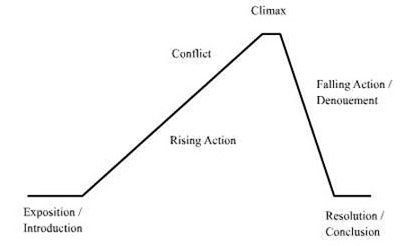
Now, a clearly marked plot can be one of the hardest things for a writer to generate. We like a character, we like a scenario, we like an adventure, but breaking it into things like “rising action” or—heaven forfend —“mid-point” is sometimes asking too much. The classical plot structure with its asymmetrical graph is often still taught in schools.
 
 Even when writers think it too simple for the complex details vying for attention, this version can help a writer think in a straight line. The evolution of film led to what is now called “the three-act plot structure”—a veritable minefield of clichés and predictable outcomes.
Don’t get me wrong. I like movies. When they’re good. I like structure and rules for stories. A six-hundred page run-on sentence about the difference between a pimple and a pickle would get old fast. Plot is a good idea.
The trouble is, an author needs the reader to want to be on the same roller coaster that she is writing. Which is why I’m using “Silver Hands” for this analysis.  As you’ll see in the summaries page, I broke down and used an extra paragraph for this story. Partly because it is a long, richly textured story that deserves more attention than I gave it, but mostly because this story breaks almost perfectly into three acts. Looking at the events of the story can make it difficult to use the classical plot structure, though. Which event is the climax? How can we have an inciting incident before we’ve meet all the characters?
This is easily answered. For the classical plot structure of this story, examine the heroine’s emotional journey. Instead of three separate and intense stories, her emotions follow one straight line. In film, this is ideally what happens. A character undergoes a series of events that all tie into one emotional journey. I believe there’s actually a little more leeway in printed media (books, short stories, poetry, etc.), but the idea is the same.
Which is why the 3-act structure is used in helping writers construct their stories. For this week, take apart Silver Hands. Use the plot graphs given here (or that you find in your own research) to break the story into its acts and actions, upheavals and downswings, development and deconstruction.
Try it. You’ll like it...

Thursday, January 19

Cinderella and Her Familiar Archetypes

When we last left our heroine, she was a one-dimensional block of inflexible ice that no editor would touch with a ten-foot pole. Or was that her mother...?
Neither, of course.
Cinderella is an archetype. In all her many forms. And most of the characters in her thousands of variations. But today, I’m just going to deal with the basic version—Cinderella, her stepmother, her sister(s), her godmother, the prince. If you want to use this on Katie Woodencloak or Bearskin, the principle is the same.
The word “archetype” is Greek—literally “first molded”, or the original pattern copied forever after. Archetypes are used by psychologists to break people down into manageable bits and pigeonhole them. (No offense. None taken.) They are also used by teachers to determine how to best reach their students. And they are used in literature, by writers who want a story to be both deep and tall. It’s not cheating to use an archetype—you as a writer just need to be sure you’re not letting your archetype do all the work for you.
1. Cinderella is our first archetype. Not so much of a “damsel in distress” as a “persecuted heroine.” She is good, thoughtful (or clever), and usually has animals helping her through rough patches. Persecuted heroines are easy for girls to identify with—we all feel persecuted, sometime.
2. The classic Evil Stepmother. This archetype is so prevalent in fairy tales that the mere mention of a stepmother prods each reader to assume the new parent will be evil. In some versions of this story, the stepmother is cruel. In others, abusive. In yet others, she meets a grisly end. But never is her treatment of Cinderella accidental or careless. She chooses another child to promote over Cinderella.
3. The step-sisters (or regular sisters, in other versions) depend on the variant you’re working from: in some versions, they are cruel to Cindy; in others, one is kinder or both are indifferent. These sisters always side with the stepmother (or parents, in other versions). Siblings don’t always get along, and here we have a good example of a family relationship from a single point of view. If Cinderella is the persecuted heroine we’re going to side with, this is the family we want her to escape. The stepmother (see above) may choose to be dreadful to her child, but that same decision by the stepsister looks very different to the reader. The stepmother may be considered with anger or hatred, but the stepsisters earn contempt. And, frequently, an added epithet of “ugly.”
A parent, after all, can be held accountable for bad behavior. A sibling or peer has no excuse, so the extra incentive of jealousy fleshes out what little personality is required for the stepsisters.
4. In other versions, Cinderella's godmother is a bull, or a sheep, or an old stick. (How the Aarne-Thompson system keeps things together or separate is a whole 'nother discussion...) All that to say, the godmother is the trickiest of all the archetypes in this story. She doesn't show up until absolutely needed, and she doesn't stick around to fix anything in the aftermath. But Cinderella is called a fairy tale because this is where the fairy comes into play. Many a writer's imagination takes flight with this archetype's inclusion. (How could I tell this story without the godmother? What if the godmother never helped--how would Cindy save herself? This is how that sneaky muse beats you over the head and makes off with your sanity...) This archetype is helpful, but not dynamic. She equips Cinderella for the party, but she DOES NOT remake Cinderella or influence anyone's decisions or actions. 

5. Be he charming or sincere, too old or too young, Cinderella must have her prince. Always, this prince is romantic enough to be enraptured by Cinderella’s beauty. But, happily for the heroine and the reader, never is he struck so dumb that he cannot act. This is fortunate. (In real life, some men can be temporarily paralyzed by a pretty girl.) Prince Charming, as an archetype, is romantic enough to swear to marry the owner of a shoe, but also restrained enough to keep from chasing Cinderella until after she runs away. (Again, real life isn’t always this cut and dried.)
Persecuted Heroines, Ugly Stepsisters, Evil Stepmothers, Laissez-faire Godmothers, and Romantic Princes aside, these are stock characters that are hard to avoid when writing. They call to deep parts of the human psyche. More the female psyche than the male one, let’s be honest, but call they do. How a writer makes the persecution realistic and engaging is up to the writer. But these are a few of the archetypes that make for a solid framework on which a good story can be built.
And the better the building, the less damage huffers and puffers can do to it. But that is another story...

Monday, January 16

Cinderella and...

Of all the stories in all the world, this may be one of the best known. So many cultures have a variant of the “little cinder girl” somewhere in their folklore. Two minutes of searching the internet will pull up sites like this, with links to hundreds more stories. All enough alike to merit their own separate listing in the Aarne-Thompson classification system (which identifies stories by elements rather than by names or happy endings). The sheer volume of adaptations in various art forms (painting, film, opera) boggles the mind. Once upon a time, I even had a fellow student ask me to find a version of Cinderella for her from the Bible.*
But why? What is so spectacularly...familiar about this tale, that it would span continents and cross countless generations?
The answer, I believe, is found in character. You see, this is not a story of change. Change in circumstance—sure. But nowhere in this story will you find a single character who changes. No dynamic characters—only static ones.
Writers, be at ease. This does not herald disaster. Modern critics are forever hounding would-be authors about the importance of “character arcs.” Your character must grow and develop, or no one will buy it. If this were the case, Cinderella would not have found so many homes throughout the world.
That is NOT to say that character development isn’t important. That is a topic I’ll save for another story. Cinderella, however, makes powerfully effective use of archetypes throughout the story, which eliminates much of the modern dependence on gimmicks. Readers do not pour through the tale, hoping the stepmother will have a change of heart. No one studies the pages of this story, waiting for the Prince to move to Tahiti and take up pearl-fishing.
We, the readers, want Cinderella to go to the ball. We want her to sweep the prince off his feet. We want justice to be served to her stepmother and stepsisters.
If Cinderella went home from the party, hid her shoe, and contentedly worked for the rest of her “happily ever after”, we would hate the story. Not because we want Cindy to change, but because we want her circumstances to change.
Archetypes get away with this sort of thing all the time in literature. They tap into people’s innermost identities so easily that the writer is excused from having to work to make us like the character. (Can you think of no recent book-to-film phenomena lately where a character so completely typifies, oh, I don’t know, a young woman’s deepest fears and insecurities about herself?) An archetype doesn’t challenge the readers’ beliefs—he or she channels those beliefs into a sweetly secure plane between faith and fantasy.
Archetypes are a gift. More on these next time—where they come from, and how writers can use them—but where can you find archetypes in the books you read? Where can you find them in your own writing?


*The question is—what should I have told her? Prize for the best answer by Friday...