Where last we left our heroine, you were cutting her into wafer-thin slices for a closer examination. Don’t be shy with your scalpel—anyone who can grow back an appendage or two must have enough alien in her to survive a plot breakdown.
Silver hands is a story full of symbolism and parable. We’ll come back to those topics at a later date—I only here bring it up because the symbolism in the story can help you find the hinge points of the plot.
Cinema’s three-act structure is an easy framework in which this story fits. (Where did it come from? Back in the day, movies were put on several reels of film. These reels had to be switched out by hand, and the theater employees who ran the projectors got bored or didn’t know when in the story the reels needed to be switched. So, movie producers changed the format of films to have three “acts.” As the climax of each reel became apparent, the person working the projector knew it was time to get the next reel ready. This format of having a cycle of three physical stories that told one emotional journey has become the prevalent modern mode of story-telling.) First act, we have the deal with the devil, the girl’s mutilation and subsequent ejection from home. Second act, we have her unexpected rescue by the king, their wholesome little marriage, and the shock of the devil’s interference. Third act, we have her husband’s desperate search for her, the new identity and miraculous recovery of her hands, and finally the reunion of the good girl and her faithful king.
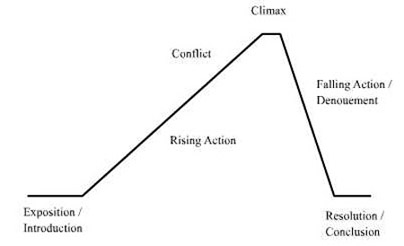
Sweet and simple. Dividing the story into the traditional plot graph—with its straight lines and uncompromising “before-and-after”—that’s a little harder. Using the symbolism to map the girl’s emotional journey helps.
The very first thing that happens in the story is the devil’s bargain with the girl’s father. Some students and writers might argue this is the inciting incident in the whole tale. Given that the reader hasn’t yet met the heroine, that’s a little premature. Although momentous and life-changing, the bargain is more of a set-up for events to come. (Keep in mind, we’re talking about a devil. He’s after the girl’s soul, which wasn’t her father’s to bargain with in the first place, so the devil will continue to pursue any chance to entrap the girl.)
A better place to put the plot’s inciting incident is when her hands are chopped off—it’s irrevocable, memorable, and marks her as unique for the rest of her life. This is another place where symbolism comes in handy—what do her clean, white hands matter when the devil wants more of her than that? (Future writers, look for these moments. When an author provides a situation or circumstance that makes the reader ask questions, these are usually clues to powerful and effective storytelling. Don’t be afraid to create questions in your own work.) The girl cannot stay in her parents’ home any more—partly because their bargain with the devil prevents her parents from offering shelter, but also because her character is sufficiently pure that she could not live in a house full of ill-gotten gain.
Good for her.
Her first venture into the forest, and her delicate thievery in the king’s orchard, start the reader on a slow accumulation of events. Both physical and emotional. When she is helpless, without friend or resource, the events are small and tug at the reader’s heart. As she gains the love and respect of a man of good family and greater resources, the circumstances and stakes begin to get larger. The impending birth. The far-off war. The devil’s interference. As the girl’s world expands to include people and situations other than her own personal drama, she begins to make choices to protect those she loves, instead of protecting herself. Though up and down in terms of intensity and emotion, these are natural escalations in the plot’s rising action.
Now, depending on your arguments and point of view, there are two possible places for the plot’s climax to be argued. One is here, where the girl flees into the forest with her infant son. You could argue that everything after this is self-explanatory. I could argue in turn that this is precisely why the heroine’s emotional journey is so important. Fleeing into the woods—again—solves nothing. The girl has a good heart and great character, but wisdom has been slow to come to this young mother. She has not yet learned when to flee from evil and when to stand her ground and fight. A wise girl would have fled her father’s home when she first learned of the bargain. Or stayed to face down her husband who dared to order the murder of their son. Supposedly.
Since wisdom is gained through experience and good counsel, I would hold off on the plot’s climax until the king finds her in the forest. She spends several years with good people who live in the dark and scary forest—they know not to run just because they are frightened. Not until the girl can exercise wisdom and bravery together does she get her happy ending.
When we (authors) develop stories, we seldom think in terms of graphs and analysis. We want to tell a story. Some adventure. A little mystery. Maybe some tingles. We can get very focused on the details of a character, an event, or how we see the threads of our story interweaving. But having a plot—a line on which to hang all the minutiae of our complicated story—this is an essential part of telling a tale.
What climax is your story climbing towards? What goals, fulfilled or otherwise, burn in your hero? What do your readers want out of the story? What do you want your story to tell, when it’s done? An unexpected miracle of renewed hands, or a deeper story of bravery and belonging? How will you get there from here?
Well, that’s a story for another day...