Thursday, April 5

The White Snake and Some Personal History

Where last we left our heroine, we hadn’t met her yet. We were marching to the beat of a different drummer, walking beside a man we’d all met before. He was capable, resourceful, and looking for a place to lay his loyalty. This man can be found in a wide range of genres, appealing to almost every demographic. Except, perhaps, young children.
You have to learn a little bit about loyalty and its value before you can read about its loss.
A soldier of fortune could also be called a mercenary, but this has negative connotations. When you say “merc”, people think of pirates and Hessians and lots of sadly failed coups across the world. Rightly so. But a soldier of fortune has left that business. For whatever wonderful reason, the human mind is more forgiving of and receptive to someone who is looking for a new start in life.
Point number one in favor of “The White Snake”—it’s about a former servant. Servant, farmer, soldier—the man who wants his new life has already had one. Unlike fairy tales about younger sons (a topic for another story, surely), soldier of fortune stories are about men with pasts. Grown-ups. They may not mature or change on the page, but their previous experience tempers their reactions to the fairy tale’s adventures.
Point number two is that this IS a new life. This story isn’t a young prince looking for a new kingdom to take over. Instead, we read about someone whose old life doesn’t necessarily fit with his new ambitions. Some of his old skill set may apply—attention to detail, responsibility, his well-honed ability to delegate—but new aptitudes and talents must be uncovered. Or our hero will die.
Nice and melodramatic, that.
Point number three is this soldier of fortune’s commitment to his new quest. While he comes with a past, it isn’t a past that ties him down. Having served faithfully before, he is now free to commit himself wholeheartedly and with full knowledge of what he’s doing. He might not have every answer for every situation, but he isn’t a man who will abandon his honor.
When we take a look at other soldier of fortune stories, there will be other aspects to ponder. These three from “The White Snake” are relevant because of how often we see echoes of them in modern stories. Heroes, looking for homes. Champions, in search of a cause. And (to paraphrase the immortal Jane Austen) husbands, in want of wives.
These soldiers of fortune are men with pasts, but these pasts fuel their drive to find a future.
As writers, we can get so wrapped around a character’s backstory that it takes up more of the tale than the actual adventure. In “The White Snake,” the servant’s quest to become a king and a husband is the latter third of the tale. Not the bulk of it. One of the side benefits of oral stories—plenty of time to soften the audience’s sympathies toward a favorite character.
The problem of backstory, illustrated with this fairy tale, is one of determining your goal for the story. Because the servant’s history before the kingdom contest is so much of the story, all the author has room for is the conclusion of the quest. We’ll see other soldier of fortune stories where backstory is not provided, and as such the reader can devote much more emotional energy to the “happily ever after” of the characters. Countless how-to books will tell young authors when and how much backstory should be applied, but you must consider the weight of it. If there is so much of it and it is so essential, as in this case, perhaps the story should be more about the backstory than the final quest.
M.M. Kaye, who I mentioned in an earlier post, grew up to write a few other novels. One of which (a personal favorite) starts with five chapters of backstory on one character. Then anywhere between a paragraph and three pages of backstory for each character she introduces. Small wonder The Shadow of the Moon weighs so much. And yes, she does have soldiers of fortune in her stories. Margaret Mitchell, who wrote in a similar vein a generation prior, didn’t dwell as much on the character’s backstory in Gone With the Wind, but she does provide copious historical backstory all throughout the plot.
It’s a style that’s discouraged today, but the problem never goes away for writers. To tell, or not to tell—and how much.
But that’s a question for another day...

Monday, April 2

The White Snake and...

“Once upon a time...” there lived a fair maid. Or a pampered princess. Or an out-of-step girl. To date, every story we’ve discussed all have one thing in common: female protagonists. According to the world population—and the most likely candidate to tell a nursery story—we should not be surprised. If more than half the world’s population is female, and the author of a story MUST choose a central character, then it follows that the majority of fairy tales should star females.
Happily, they don’t always.
Some of the most interesting fairy tales are “soldier of fortune” stories. The main character is generally male, often poor or footloose, and looking for adventure. Or whatever comes his way, to quote an old 70’s song. “The White Snake” is one such tale.
Some stories, when read in their entirety (instead of the chopped-off summaries I provide), are meant to be told aloud. Again, this should make sense. Many old stories were passed down orally, by people who had neither time nor education to learn to read. To help the teller’s memory and the audience’s participation, these stories frequently have a trademark rhythm. Events, or speeches, happen repeatedly in cycles that are easy to remember and mimic.
Now, The White Snake would be memorable even without the rhythm of questions and offers. Even without any names in the story, this is a tale you could pick out of any line-up in any suspicious editor’s office. The frame of the story is not so amazingly unique that it could never be mistaken for anything else. Why, then, could the reader always identify it?
There are specific elements of the story that make it unique—if only for the order in which they happen—but more on that next time. Ponder some stories you know that feature boys (or men) who are strong, smart, and in search of a home. Can you think of a lot, or only a few? Especially in certain genres, these male characters may not be the central protagonist, though they often appear as heroes in certain female fantasy genres.
If we don’t read a lot of this kind of fairy tale, then why do we find so many soldiers of fortune in our modern stories?

Monday, March 26

Jesus and the Dynamic Character

Students of the craft of writing often divide their characters into two camps--protagonists and antagonists. This isn't wrong. It can be limiting, however, when the lines between the camps aren't so black and white. Sometimes, the goals of the different characters are so diametrically opposed that it cannot be argued that the characters are even on different sides.

Take, for example, the story of Jesus' visit to Sychar. (A village in ancient Samaria where Jacob's Well was located.) Antagonists are hard to find in this historical account. But characters abound. And these characters can be divided into two very clear camps: static and dynamic characters.

A static character is one whose nature and traits do not change between her first introduction on the page and the last glimpse the reader has of her. A dynamic character does change. Within the writing community, there is an assumption that dynamic characters are good, and static characters are bad. This assumption is made on the belief that readers always want their main characters to change.

And you know what "they" say about assumptions...

As we have seen over the last weeks, characters with flaws are appealing to the human psyche. (Yes, really. See Rapunzel if you missed it the first time around.) But we have also seen that protagonists don't have to change to be universally loved. (See Cinderella for that argument.) Some of the characters in John 4 are static, and others are dynamic. This story, written by the best Author, expresses both the changes and the immovability of the characters through dialogue and interaction.

Jesus: A static character if ever you've met one. This man Does Not Change. Which isn't bad. If this story is your first encounter with him, you might want to read further, but from his first breath on the page, he is committed to one goal, one purpose, one way. How that commitment plays out in his interaction with other people depends on the person. With the woman, he invites her to speak. He then answers her question in a fashion that gives her the freedom to ask another question. Anything she likes. He discovers in her a deep desire for truth, and a hopelessness that it can never be hers, and answers her heart. Not her sins. Not her past. He has come looking for her soul. (Calvin Miller does a wonderful interpretation of this in his poem The Singer, chapter XI.)

His goals do not change when others enter the scene--be they his beloved disciples, or the townspeople who do not know what to believe. But being a static character does not make him less of a powerful force in this story. His goal will not change if his audience rejects it, but both the giver and the receiver in such a conversation would come away profoundly marked by the interaction.

The Woman: Our darling dynamic character. When she enters the story, she is alone. Friendless, even for having had a string of intimate relationships. Jesus does not offer to become part of this string--or even replace it. He offers her truth, where until now she has heard only lies. The freedom and joy with which she responds profoundly mark her for the rest of her life.

When she arrives at the well, it is the middle of the day. Any sensible woman would have gone to the well at dawn, before the day was hot and household chores needed attention. But this woman wasn't welcome with others, so she came alone. This one conversation with Jesus releases her from the shame of her past choices, so that she can run into town to find the people who do not speak to her and say, "Come and meet a man who knows my secrets." The townspeople already know her secrets--this is not a surprise. But they don't know her joy. This is new. Worth investigating.

The Disciples: These fellas are such an interesting bag of tricks. Dividing them into static and dynamic individually is easy (Thomas, Peter, John, Judas), but as a group? Best to side with static in this instance. When they find Jesus freely talking with a fallen woman, righteousness demands a certain code of conduct. Withdrawal. Concern. Perhaps even a little preaching. Jesus does not rebuke them outright, but neither do we observe a change in their understanding. Their questions indicate their own search for truth, echoed in the woman's enthusiastic evangelism.

The disciples, unlike the woman, have chosen their giver of truth. They are out to follow their rabbi, wherever that teaching may lead. That doesn't stop them from expecting him to follow their code of standards, but it does open their minds to the possibility of Jesus changing their standards to match his. As with almost every other account of the disciples' interaction with Jesus, these characters are on a long, slow journey to change. Sufficiently slow that their individual characters can be measured.*

The Townspeople: Like the woman, these are also dynamic characters, though on a lesser scale than she. Their response to Jesus' teaching is to him, not to the world around them. Where she rushed to invite people--friends, strangers, enemies--to see him, they rush to pursue him. Again, this isn't bad. A writer who shows that some people are changed profoundly by an encounter with Jesus, while others react to a lesser degree, tells a very real story. Not every character will respond to another character in the same way. Writers who fail to take this into account do their readers a great disservice.

This story, like many of the fairy tales we've covered so far, begs the question of a reader's response. Reading a story does not have to change the reader. But it could. A reader is not required to be a force of change in her world. But she could. In this story, both Jesus and the woman moved others around them to change. Not because they were both dynamic characters, but because both characters demanded a response from the other characters in the story.

Like the woman at the well, writers and readers are at a crossroads. We can choose to change--or not. We can choose to challenge others to change--or not. Having made the choice, where will the next road take you?


*In my small understanding, there are two exceptions to this: Nathaniel, called Bartholomew, and Jude the Lesser, called Thaddeus. My personal studies have shown that these disciples' decisions to change and responses to their choices were profoundly different. (In your own studies, you might find other disciples whose lives affect you differently.) Why? That is very much a story for another day...

Friday, March 23

Beauty, the Beast, and Great Expectations

When last we left our heroine, she had bargained herself to save her father. Woe unto her, for her life was over! Or is it...
Whether young Beauty went into the castle expecting to be executed is anyone’s guess. She might (reasonably) have expected imprisonment. Without a doubt, she should not have expected to be made mistress of the castle upon her arrival. Unless, of course, she’d heard this story before.
Then, she could expect to be handed the keys immediately, and her reign of terror—you know, hearts, butterflies, and cuppy-cake gumdrops—could commence. The beast would be her eternal slave, and she would never want for anything.
Hmm. Perhaps she didn’t expect the royal treatment she received.
The impression I get from the frame of the story is that Beauty does not enter into the bargain with great expectations. But I do believe she develops some as the story progresses. She does not ask for much initially, though the beast insists on giving her everything he can. Especially his hand in marriage.
Whether or not that offer is much of a bargain is open to debate. As with the prince in the story of Sleeping Beauty, the beast’s rapid attachment and lack of relationship-developing obstacles present the reader with good reason to be suspicious. As Beauty chooses not to capitulate to the inevitable so quickly, she must have some other expectation for her life.
Or else she didn’t get the memo.
Beauty, as is NORMAL for a young girl, does not start out her life expecting to marry a beast. Time and exposure to one do not change that expectation. She still won’t marry him. (In some versions, Beauty has nightly dreams of a handsome prince who wants to know why she doesn’t love him. If that’s not an invitation to psychoanalysis, I will eat my hat.) Even when she begins to realize that she—the beast’s prisoner—can ask for a vacation—or, let’s be honest, anything she wants—she still does not want to marry the beast. “He’s just a friend.”
When she returns from being away (sometimes by magic, sometimes by a hard journey), the beast does manage to get her to say “I love you.” Not an acceptance of his many proposals, but close enough for government work. Or a curse, in this case. But still, Beauty doesn’t agree to marry a beast. She agrees to marry the handsome prince he turns into, once the spell is lifted.
This is always the part that worries me. The part in “fairy tales” where girls agree to marry the handsome princes that the beasts, toads, or other monsters “revert to” once the curse is gone. We see this in a lot of other stories. Robin McKinley likes this story so much she rewrote it twice (Beauty and Rose Daughter). Pride and Prejudice, where Elizabeth does not agree to marry Darcy until he transforms into a kind, generous man. Don’t get me wrong—there are many, many things I love about Jane Austen—but this aspect of the fairy tale bothers me.
If you give a girl a hero who has to change in order to get that ring on her finger, what is that going to do to the reader’s expectations in her own everyday fairy tales? Will a reader really go around kissing frogs until one just happens to turn into a prince? What if he stays a beast? What if he’s smart enough to pull a bait-and-switch? (A fraudulent method of convincing someone to buy the wrong thing for too much.)
And what will this do to all the Perfectly Normal Beasts out there? (“What’s wrong with them?” “Not a thing. It’s why they’re called Perfectly Normal.” Gotta love Douglas Adams at his most obscure...) Is this a fairy tale that will damage the reader to the point of damaging her future relationships?
Hate to leave you hanging, but that’s a story for another day.
Or, perhaps, one you should write. To correct that wrong...

Monday, March 19

Beauty, the Beast, and...

Once there was a girl, so brave, so true, that her willingness to sacrifice herself for someone she loved changed the heart of a great and terrible beast. Who was actually a cursed prince. And then they live happily ever after. Yes, this one is an old, familiar tale.
Which some people I know like to argue is the most Christ-like of the major fairy tales, because of the sacrifice substitution. And some other people I know like to argue is entirely about limited opportunities and Stockholm Syndrome.* Clearly, Beauty and the Beast is one of those stories that depends a great deal on the reader’s point of view.
Sadly, I won’t be discussing point of view this week. When Alex Flinn’s Beastly became a motion picture last year, point of view (or POV, for short) suddenly became a relevant part of fairy tales. Mostly because she writes from unusual POVs (the beast, the ugly stepsister, and so on). It’s an interesting concept, but it’s better discussed with other fairy tales. Maybe later.
No, this week I want to focus on young Beauty. As a writer, you are sometimes left with the very serious decision of what to reveal in a story, and what to leave out. Beauty’s motivation in agreeing to the trade—herself for her father—is an easy one for a reader to trace. Had she thought about the permanence of this choice? What if the beast ate her? What if she lived for sixty years in prison, and never went home? What had she expected, going into her imprisonment?
There are some other places where Beauty’s expectations come into play, but that’s more a question for next time. (Ethics and themes and whatnot.) In the story, the reader is shown how Beauty stays brave and true, consistently turning down the beast throughout her confinement. But how—and when—does she change her mind about him?
What would her diary entries from this time in the story reveal about her plans for the future, her thoughts on the castle and her home?


*Stockholm Syndrome refers to a situation where a captive "falls in love" with his or her captor. This is a serious and dangerous psychological condition, usually accompanied by the captor manipulating the prisoner and forcing a false sense of dependency. Beware!

Thursday, March 15

Silver Hands and a Reliable Plot

Where last we left our heroine, you were cutting her into wafer-thin slices for a closer examination. Don’t be shy with your scalpel—anyone who can grow back an appendage or two must have enough alien in her to survive a plot breakdown.
Silver hands is a story full of symbolism and parable. We’ll come back to those topics at a later date—I only here bring it up because the symbolism in the story can help you find the hinge points of the plot.
Cinema’s three-act structure is an easy framework in which this story fits. (Where did it come from? Back in the day, movies were put on several reels of film. These reels had to be switched out by hand, and the theater employees who ran the projectors got bored or didn’t know when in the story the reels needed to be switched. So, movie producers changed the format of films to have three “acts.” As the climax of each reel became apparent, the person working the projector knew it was time to get the next reel ready. This format of having a cycle of three physical stories that told one emotional journey has become the prevalent modern mode of story-telling.) First act, we have the deal with the devil, the girl’s mutilation and subsequent ejection from home. Second act, we have her unexpected rescue by the king, their wholesome little marriage, and the shock of the devil’s interference. Third act, we have her husband’s desperate search for her, the new identity and miraculous recovery of her hands, and finally the reunion of the good girl and her faithful king.
Sweet and simple. Dividing the story into the traditional plot graph—with its straight lines and uncompromising “before-and-after”—that’s a little harder. Using the symbolism to map the girl’s emotional journey helps.
The very first thing that happens in the story is the devil’s bargain with the girl’s father. Some students and writers might argue this is the inciting incident in the whole tale. Given that the reader hasn’t yet met the heroine, that’s a little premature. Although momentous and life-changing, the bargain is more of a set-up for events to come. (Keep in mind, we’re talking about a devil. He’s after the girl’s soul, which wasn’t her father’s to bargain with in the first place, so the devil will continue to pursue any chance to entrap the girl.)
A better place to put the plot’s inciting incident is when her hands are chopped off—it’s irrevocable, memorable, and marks her as unique for the rest of her life. This is another place where symbolism comes in handy—what do her clean, white hands matter when the devil wants more of her than that? (Future writers, look for these moments. When an author provides a situation or circumstance that makes the reader ask questions, these are usually clues to powerful and effective storytelling. Don’t be afraid to create questions in your own work.) The girl cannot stay in her parents’ home any more—partly because their bargain with the devil prevents her parents from offering shelter, but also because her character is sufficiently pure that she could not live in a house full of ill-gotten gain.
Good for her.
Her first venture into the forest, and her delicate thievery in the king’s orchard, start the reader on a slow accumulation of events. Both physical and emotional. When she is helpless, without friend or resource, the events are small and tug at the reader’s heart. As she gains the love and respect of a man of good family and greater resources, the circumstances and stakes begin to get larger. The impending birth. The far-off war. The devil’s interference. As the girl’s world expands to include people and situations other than her own personal drama, she begins to make choices to protect those she loves, instead of protecting herself. Though up and down in terms of intensity and emotion, these are natural escalations in the plot’s rising action.
Now, depending on your arguments and point of view, there are two possible places for the plot’s climax to be argued. One is here, where the girl flees into the forest with her infant son. You could argue that everything after this is self-explanatory. I could argue in turn that this is precisely why the heroine’s emotional journey is so important. Fleeing into the woods—again—solves nothing. The girl has a good heart and great character, but wisdom has been slow to come to this young mother. She has not yet learned when to flee from evil and when to stand her ground and fight. A wise girl would have fled her father’s home when she first learned of the bargain. Or stayed to face down her husband who dared to order the murder of their son. Supposedly.
Since wisdom is gained through experience and good counsel, I would hold off on the plot’s climax until the king finds her in the forest. She spends several years with good people who live in the dark and scary forest—they know not to run just because they are frightened. Not until the girl can exercise wisdom and bravery together does she get her happy ending.
When we (authors) develop stories, we seldom think in terms of graphs and analysis. We want to tell a story. Some adventure. A little mystery. Maybe some tingles. We can get very focused on the details of a character, an event, or how we see the threads of our story interweaving. But having a plot—a line on which to hang all the minutiae of our complicated story—this is an essential part of telling a tale.
What climax is your story climbing towards? What goals, fulfilled or otherwise, burn in your hero? What do your readers  want out of the story? What do you want your story to tell, when it’s done? An unexpected miracle of renewed hands, or a deeper story of bravery and belonging? How will you get there from here?
Well, that’s a story for another day...

Monday, March 12

Silver Hands and...

While I still have several more of the “classic” fairy tales to go, I didn’t want to leave the question of Plot alone too long. This story is a lesser known tale, and the version I have summarized here is an amalgam of two of the better versions I’ve come across. You are welcome to do some research on your own. (Aarne-Thompson classifies it as type 706--"The Armless Maiden.") Since this is an older, less known story, some versions have elements that are unfamiliar to our modern sensibilities (in terms of morals, cultural norms, and symbolism).
Silver Hands—also called “The Orchard”—became one of my favorite fairy tales after I grew up. I never heard of it as a child (which is saying something, since I devoured fairy tales back in the day). Clarissa Pinkola Estes, who I’ve quoted before in this blog, does an extraordinary job of breaking this story into its pieces and parts in her book Women Who Run With the Wolves. I do not intend to dissect the story here, but this story is ideal for mapping out a plot.
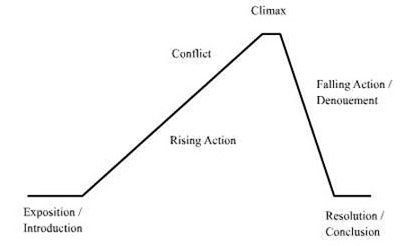
Now, a clearly marked plot can be one of the hardest things for a writer to generate. We like a character, we like a scenario, we like an adventure, but breaking it into things like “rising action” or—heaven forfend —“mid-point” is sometimes asking too much. The classical plot structure with its asymmetrical graph is often still taught in schools.
 
 Even when writers think it too simple for the complex details vying for attention, this version can help a writer think in a straight line. The evolution of film led to what is now called “the three-act plot structure”—a veritable minefield of clichés and predictable outcomes.
Don’t get me wrong. I like movies. When they’re good. I like structure and rules for stories. A six-hundred page run-on sentence about the difference between a pimple and a pickle would get old fast. Plot is a good idea.
The trouble is, an author needs the reader to want to be on the same roller coaster that she is writing. Which is why I’m using “Silver Hands” for this analysis.  As you’ll see in the summaries page, I broke down and used an extra paragraph for this story. Partly because it is a long, richly textured story that deserves more attention than I gave it, but mostly because this story breaks almost perfectly into three acts. Looking at the events of the story can make it difficult to use the classical plot structure, though. Which event is the climax? How can we have an inciting incident before we’ve meet all the characters?
This is easily answered. For the classical plot structure of this story, examine the heroine’s emotional journey. Instead of three separate and intense stories, her emotions follow one straight line. In film, this is ideally what happens. A character undergoes a series of events that all tie into one emotional journey. I believe there’s actually a little more leeway in printed media (books, short stories, poetry, etc.), but the idea is the same.
Which is why the 3-act structure is used in helping writers construct their stories. For this week, take apart Silver Hands. Use the plot graphs given here (or that you find in your own research) to break the story into its acts and actions, upheavals and downswings, development and deconstruction.
Try it. You’ll like it...